Laparoscopic vs. Da Vinci Robotic Surgery: Differences, Recovery, and Costs
Da Vinci robotic surgery uses 3D wristed tools for complex operations, while laparoscopy uses rigid manual tools. Compare recovery, benefits, and costs.

Laparoscopic vs. Da Vinci Robotic Surgery: Differences, Recovery, and Costs
Quick Answer: Laparoscopic surgery uses rigid handheld tools and a 2D camera, while da Vinci robotic surgery translates a surgeon's hand movements into tremor-filtered, 3D-magnified micro-movements using articulating instruments. Both techniques use small incisions and promote fast healing, but robotic systems offer distinct precision advantages in confined anatomical spaces at a higher procedural cost.
Key Takeaways:
- Conventional laparoscopy involves manual manipulation of straight instruments, whereas robotic platforms provide wristed tools with seven degrees of motion.
- High-definition 3D binocular visualization in robotic consoles improves depth perception compared to standard flat-screen 2D laparoscopy monitors.
- Robotic assistance demonstrates clear clinical value in complex pelvic and reconstructive procedures like radical prostatectomy and partial nephrectomy.
- Routine procedures such as standard gallbladder removal often achieve equivalent clinical outcomes and recovery speeds with conventional laparoscopy.
- Surgeon experience and annual case volume remain stronger predictors of surgical success and low complication rates than the choice of robotic platform alone.
Minimally invasive surgery refers to surgical techniques performed through several small incisions rather than a single large opening. By using narrow access ports, miniature cameras, and specialized instrumentation, surgeons access internal organs while minimizing trauma to abdominal wall muscles and surrounding tissues. Patients undergoing minimally invasive procedures generally experience less postoperative discomfort, reduced wound complications, and a faster return to daily activities than those treated with traditional open surgery.
Laparoscopic vs. Robotic Surgery: What Is the Fundamental Difference?
Laparoscopic surgery relies on rigid, handheld instruments manipulated directly by the surgeon at the operating table, whereas robotic surgery uses wristed instruments controlled through a computerized console with high-definition 3D visualization and tremor filtration.
When evaluating what is robotic surgery compared to standard techniques, the primary difference lies in the interface between the surgeon and the patient. In laparoscopy, the surgeon stands beside the operating table, holding long, straight-shaft instruments that pivot across the abdominal wall. This setup creates a fulcrum effect: moving the hand left moves the instrument tip right, requiring mental adaptation and inverted manual coordination.
In contrast, a robotic surgical platform functions as a master-slave telemanipulator. The surgeon sits at an ergonomic console a few feet away from the patient, viewing a magnified stereoscopic image. The console captures hand, wrist, and finger movements, filtering out natural physiological tremors and scaling motions down for high precision. Robotic platforms also eliminate the fulcrum effect, allowing the instrument tips inside the body to move in exact synchrony with the surgeon's natural hand direction.
How Conventional Laparoscopic Surgery Works
In conventional laparoscopy, surgeons make small incisions (5 to 12 mm), insufflate the abdomen with carbon dioxide, and insert a 2D camera along with long, straight instruments to perform the operation manually.
To understand what is laparoscopic surgery in clinical practice, it helps to examine its technical workflow:
- Abdominal Insufflation: The surgical team creates a working space by inflating the peritoneal cavity with medical-grade carbon dioxide gas (pneumoperitoneum).
- Port Placement: Trocar sleeves (hollow access tubes) are positioned across the abdominal wall to serve as instrument channels.
- Laparoscope Insertion: A lighted rod-lens telescope connected to a high-definition camera transmits live 2D video to monitors in the operating room.
- Manual Manipulation: The surgeon and assistant insert graspers, scissors, electrocautery hooks, and clip appliers through secondary ports to dissect tissue, control bleeding, and reconstruct structures.
- Closure: Once the target tissue is treated or removed, the team evacuates the gas and closes the small fascial and skin incisions with absorbable sutures or surgical adhesive.
Laparoscopy requires refined hand-eye coordination. Because standard monitors display a flat, two-dimensional image, the operating surgeon infers depth through anatomical cues, tissue shadows, and tactile feedback.
How Da Vinci Robotic-Assisted Surgery Works
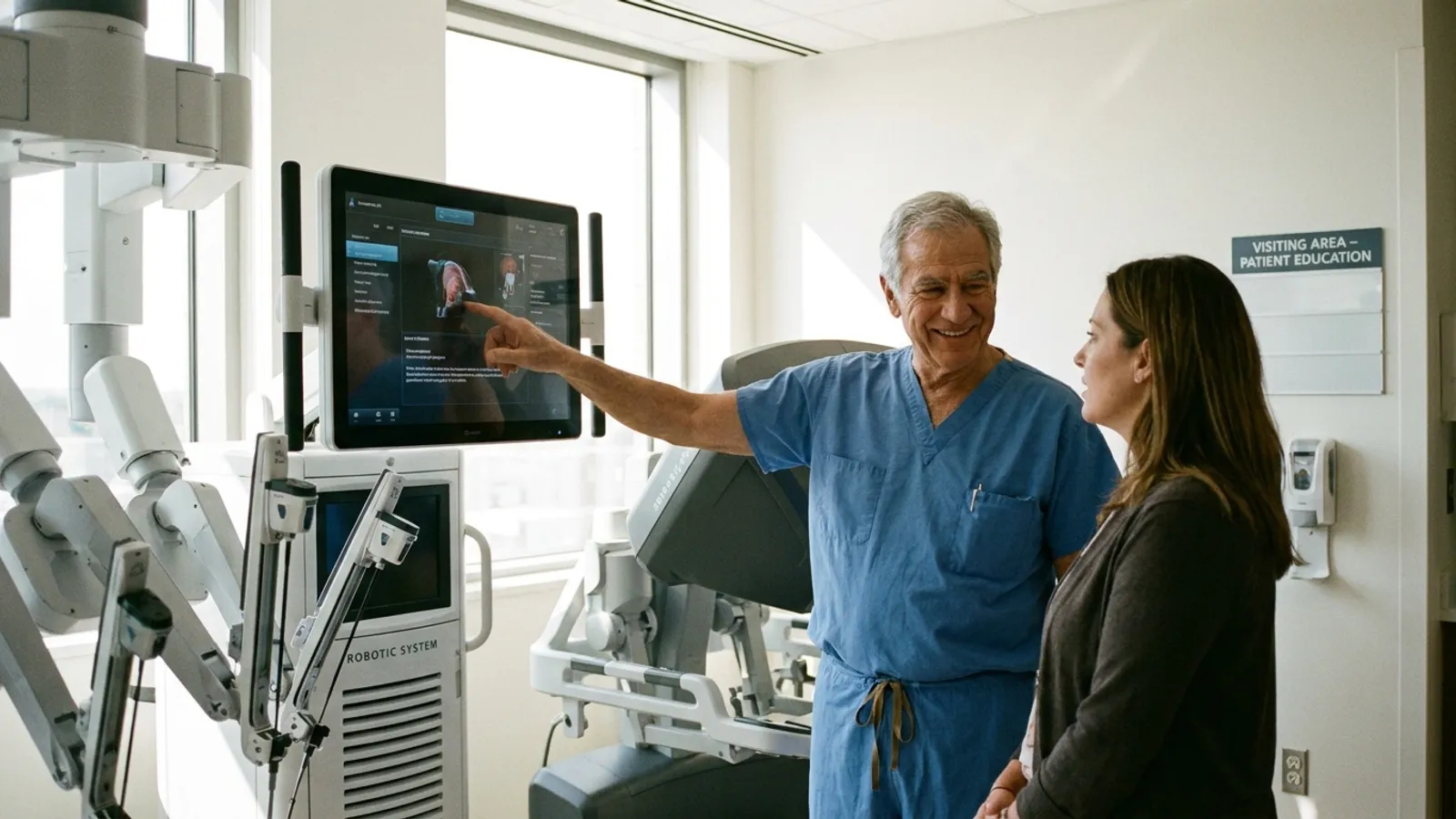
Robotic-assisted surgery positions the surgeon at an ergonomic master console to control articulated robotic arms equipped with EndoWrist instruments that provide seven degrees of freedom and magnified 3D binocular vision.
During a da Vinci robotic surgery procedure, the mechanical system does not act independently. Every movement of the robotic arms is driven in real time by the operating surgeon. The platform consists of three core components:
- The Surgeon Console: An ergonomic control station where the lead surgeon sits, looking into a binocular viewer that delivers true 3D high-definition images magnified up to 10 times. Master controls translate finger and wrist motions directly to the instruments inside the patient.
- The Patient Cart: A multi-armed cart positioned next to the operating table. One arm holds the 3D endoscope, while two or three additional arms hold articulating surgical tools.
- The Vision Cart: A processing tower that manages image integration, electrocautery generators, and communication between the console and the patient cart.
The system's articulating instruments bend and rotate beyond the natural range of the human wrist. This agility allows surgeons to dissect around delicate neurovascular bundles, maneuver around corners, and place fine reconstructive sutures in tight anatomical spaces where straight laparoscopic tools face mechanical limitations.
Clinical Applications: When Robotic Surgery Outperforms Laparoscopy
Robotic assistance offers distinct advantages in confined anatomical spaces requiring intricate dissection and delicate suturing, such as radical prostatectomy, complex partial nephrectomy, and deep pelvic endometriosis, whereas standard laparoscopy remains highly efficient for routine cholecystectomy and uncomplicated hernia repair.
Surgical platforms differ in utility depending on the complexity of the organ system, tissue fragility, and operative field:
- Urology: For prostatectomy, robotic surgery has become the standard clinical approach. The narrow male pelvis makes nerve-sparing dissection and delicate urethrovesical anastomosis technically challenging with straight laparoscopic tools. Robotic systems help surgeons preserve the microscopic cavernous nerves responsible for erectile function and urinary continence.
- Nephrectomy: In robotic surgery kidney procedures, specifically partial nephrectomy, the platform's wristed needle drivers allow rapid tumor excision and precise renal reconstruction, minimizing the warm ischemia time during which blood flow to the kidney is temporarily clamped.
- Gynecology: In complex hysterectomy, robotic surgery provides superior dexterity when removing large fibroids (myomectomy), dissecting deep infiltrating endometriosis from the bowel and ureters, or performing pelvic lymph node dissections for endometrial cancer.
- General Surgery: For routine gallbladder removal, robotic surgery provides outcomes comparable to standard laparoscopy, which remains the primary, cost-effective standard. However, in complex ventral hernia, robotic surgery allows surgeons to suture the abdominal wall layers closed and place reinforcing mesh in retro-rectus spaces without large open incisions.
| Procedure | Laparoscopic Suitability | Robotic Suitability | Primary Platform Advantage |
|---|---|---|---|
| Radical Prostatectomy | Moderate (Steep learning curve) | High (Preferred standard) | Enhanced nerve preservation and delicate reconstructive suturing in the narrow pelvis |
| Partial Nephrectomy | Moderate | High | Rapid tissue reconstruction to shorten renal ischemia time |
| Complex Hysterectomy / Myomectomy | Moderate to High | High | Articulated tools facilitate multi-layer uterine suturing and dissection near ureters |
| Routine Cholecystectomy | High (Gold standard) | High | Equivalent clinical outcomes; laparoscopy remains more cost-effective |
| Inguinal / Ventral Hernia Repair | High | High | Robotic wrist action helps close large fascial defects under tension |
Recovery Timeline, Pain Levels, and Complication Risks Compared
Both laparoscopic and robotic surgeries significantly reduce recovery times, blood loss, and infection rates compared to open surgery; however, robotic techniques may offer modest reductions in postoperative opioid use and shorter hospital stays in complex pelvic and reconstructive operations.
When comparing recovery from laparoscopic surgery to robotic-assisted procedures, both approaches share the primary benefits of minimally invasive access. Because neither approach requires large muscle-cutting incisions, postoperative discomfort is markedly lower than in open surgery, and patients experience lower rates of wound infections and incisional hernias.
Most patients undergoing routine laparoscopic or robotic procedures (such as cholecystectomy or uncomplicated hernia repair) return home the same day or within 24 hours. Normal light activities typically resume within 1 to 2 weeks, with heavy lifting restricted for 4 to 6 weeks.
In major reconstructive operations (such as radical prostatectomy or complex pelvic reconstructions), clinical studies report slightly reduced intraoperative blood loss and lower rates of blood transfusion with robotic platforms. However, overall recovery milestones, such as time to bowel function return, wound healing rates, and return to work, are broadly comparable between experienced laparoscopic and robotic surgical teams.
Why Does Robotic Surgery Cost More Than Laparoscopy?
Robotic surgery carries higher costs due to multi-million dollar system acquisition prices, recurring annual service contracts, and proprietary single-use or limited-reuse instruments that add $1,500 to $3,500 in direct expenses per procedure.
The cost disparity between the two approaches stems from several logistical and capital factors:
- Capital Equipment Costs: A modern da Vinci robotic system typically costs hospital facilities between $1.5 million and $2.5 million USD to purchase.
- Maintenance Agreements: Annual service and software contracts add $100,000 to $200,000 USD per year per machine.
- Instrument Depletion: Robotic EndoWrist instruments contain microchips that limit their use to a set number of procedures (usually 10 to 15 cycles) before the software locks them out to maintain mechanical safety margins. Each instrument replacement adds direct per-case expense.
- Operating Room Time: Initial setup and robotic arm docking can add 15 to 30 minutes to operative room scheduling, especially in centers with developing surgical teams.
By comparison, laparoscopic towers cost less to purchase, use non-proprietary instruments that can be sterilized hundreds of times, and do not require multi-arm draping protocols.
How to Decide Between Laparoscopic and Robotic Options
Patients should choose based on surgeon case volume and expertise rather than the machine alone, balancing the specific technical demands of the procedure against available insurance coverage and facility costs.
When evaluating your surgical approach, consider the following decision points:
- Surgeon Experience: A high-volume laparoscopic surgeon with extensive experience generally achieves better clinical outcomes than a low-volume surgeon using a robotic platform, and vice versa.
- Procedural Complexity: For straightforward procedures (like routine appendectomy or standard gallbladder removal), conventional laparoscopy delivers comparable outcomes at lower cost. For complex dissections involving delicate nerves, blood vessels, or extensive suturing, robotic platforms offer clear mechanical benefits.
- Anatomical Factors: Prior abdominal surgeries with extensive scar tissue (adhesions), high body mass index (BMI), or deep pelvic anatomy often favor the visualization and mechanical leverage of robotic systems.
- Insurance Coverage and Out-of-Pocket Costs: Many commercial insurers and national health programs cover robotic-assisted surgery for recognized indications without additional patient copays, but facility fees or non-covered consumable fees can vary between private centers.
Risks and Safety Considerations in Minimally Invasive Surgery
Minimally invasive operations carry general surgical risks, such as bleeding, infection, visceral injury, and anesthetic complications, alongside specific risks like equipment failure or conversion to open surgery.
While both laparoscopic and robotic techniques are generally safe, patients should understand the realistic complication profiles:
- Accidental Organ or Vascular Injury: Insertion of access trocars carries a small risk (reported at under 0.5% in most elective settings) of injuring the bowel, bladder, or major retroperitoneal blood vessels.
- Conversion to Open Surgery: If severe bleeding, unexpected dense adhesions, or anatomical ambiguity occurs, the surgical team may safely convert the operation to a standard open incision. Conversion rates are typically low (1% to 5% in elective cases) and reflect prioritizing patient safety over minimally invasive completion.
- Carbon Dioxide-Related Discomfort: Carbon dioxide used for insufflation can irritate the phrenic nerve, causing transient shoulder tip discomfort that typically subsides within 48 to 72 hours.
- System Malfunction: Robotic systems include built-in safety interlocks and auto-brakes. Mechanical or software errors requiring immediate system restart or conversion to laparoscopy occur in less than 0.5% to 1% of cases.
- Blood Clots (DVT/PE): As with any major abdominal or pelvic surgery, there is a risk of developing deep vein thrombosis, which requires preventive measures like compression devices and early mobilization.
Seek immediate medical attention if you experience severe worsening abdominal pain, persistent fever above 101°F (38.3°C), shortness of breath, continuous nausea with vomiting, or expanding redness and discharge at incision sites.
Frequently Asked Questions
Does the da Vinci robot perform the surgery autonomously?
No, the robotic system cannot perform any action on its own and has no autonomous programming. Every cut, grasp, and suture is controlled directly and in real time by the surgeon sitting at the console. If the surgeon looks away from the console viewer or removes their hands from the masters, the system immediately locks the instruments in place.
Is robotic surgery safer than traditional laparoscopic surgery?
Robotic surgery and laparoscopic surgery have comparable overall safety profiles when performed by experienced teams. Robotic systems provide higher visual magnification and tremor reduction, which helps reduce blood loss during complex dissections, but overall complication rates depend far more on patient health and surgeon expertise than on the tool used.
Will health insurance cover da Vinci robotic surgery?
Most health insurance providers cover robotic-assisted procedures under the same clinical codes and coverage rules as conventional laparoscopic surgery. However, coverage depends on the specific medical indication and whether the procedure is deemed medically necessary. Patients should verify whether their hospital or surgical group charges separate facility fees for robotic consumables.
How do scars differ between robotic and laparoscopic approaches?
Both methods use several small puncture incisions ranging from 5 mm to 12 mm across the abdomen, resulting in minimal cosmetic scarring compared to traditional open surgery. In some robotic procedures, ports may be spread slightly wider apart across the abdomen to prevent the mechanical robotic arms from colliding externally during surgery.
Not sure which hospital is right for your case?
Upload your medical reports and our AI will match them against the verified capabilities of every hospital in our network.
- Upload your reports (no account needed)
- Our AI matches your case with hospitals that can actually treat it
- You choose who receives your case. We present it in the hospital’s own language, and the hospital replies directly to you
Free and anonymous. Your documents stay private until you decide to send them.