

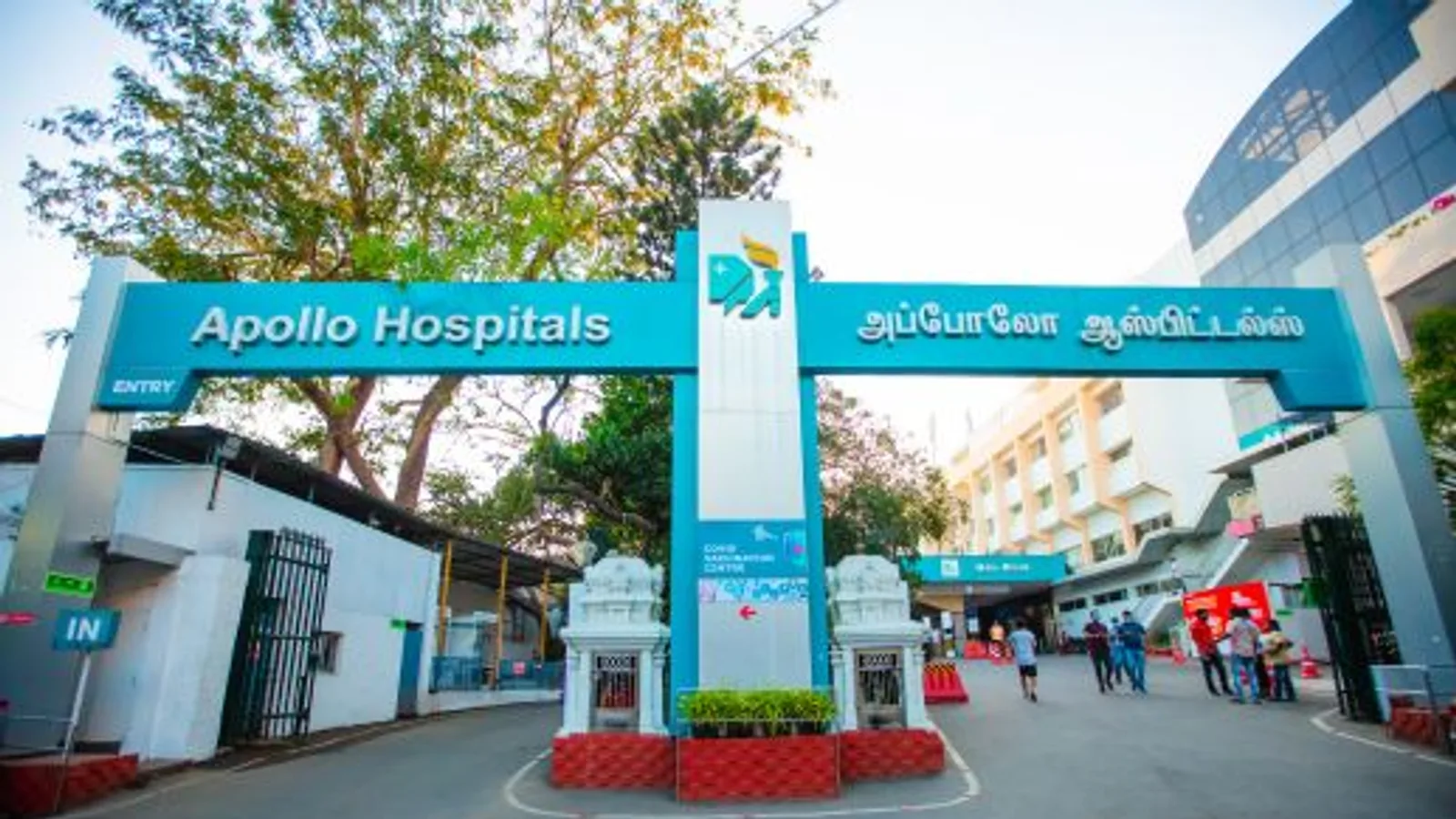

Apollo Hospitals Chennai
Chennai

- Specialties
- 27
- Departments
- 29
Not sure which hospital fits your case?
Upload your medical records and let AI match you to the right hospital.
Upload records and get matchedAbout
Apollo Hospitals, founded in 1983 by Dr. Prathap C. Reddy, is India's first corporate hospital and the country's first JCI-accredited hospital group, widely credited with pioneering private healthcare in India. The Chennai facility on Greams Road is the group's flagship, a quaternary multispecialty centre serving patients from more than 140 countries. It is recognised for cardiac sciences, oncology including South Asia's first proton therapy programme and CAR-T cell therapy, and a comprehensive transplant programme covering heart, lung, liver, kidney and bone marrow transplantation, with its Centre for Liver Disease among the world's most experienced. Further strengths include neurosciences, orthopaedics and sports medicine, urology, and minimally invasive and robotic surgery supported by advanced imaging and operating technology. The hospital holds JCI, NABH and NABL accreditation.
Specialties
Departments
- Cardiac Sciences
- Medical and Surgical Oncology
- Hemato-Oncology and Bone Marrow Transplant
- Neurosciences
- Spine Surgery
- Gastroenterology
- Gastrointestinal Surgery
- Orthopaedics and Sports Medicine
- Urology
- Nephrology
- Organ Transplantation
- Pulmonology and Respiratory Medicine
- Thoracic Surgery
- Obstetrics and Gynaecology
- Reproductive Medicine and Fertility
- Breast Health
- Paediatrics
- Bariatric Surgery
- General Surgery
- Colorectal Surgery
- Robotic Surgery
- Interventional Radiology
- Cosmetology and Plastic Surgery
- Dermatology
- Endocrinology and Diabetes Care
- Ophthalmology
- ENT
- Dentistry
- Preventive Health and Check-up
Procedures
Bariatric and Metabolic Surgery
Cardiology and Cardiovascular Surgery
Dental, Oral and Maxillofacial Surgery
Ear, Nose and Throat
General Surgery
Gynecology and Obstetrics
IVF and Reproductive Health
Neurology and Neurosurgery
Organ Transplantation
Orthopedics and Traumatology
Plastic and Aesthetic Surgery
International patient services
- International patient office
- Interpreter and translation services
- Visa and travel assistance
- Airport transfer
- Accommodation assistance
Technologies and equipment
CyberKnife M6
CyberKnife M6 is a robotic system for stereotactic radiosurgery and stereotactic body radiotherapy (SBRT). Despite the name, there is no knife and no cutting. A small linear accelerator sits on a computer-guided robotic arm and delivers many thin beams of focused radiation from hundreds of angles. The beams converge on the tumour with sub-millimetre accuracy, so a high dose reaches the target while nearby healthy tissue is spared. Imaging during treatment tracks the tumour continuously, and a motion-synchronisation feature follows targets that move with breathing, such as those in the lung or liver. Treatment is non-invasive and painless, needs no rigid head frame, and is usually given as an outpatient over one to five sessions. The decision is always made individually by the radiation oncology team.
ESWT (Extracorporeal Shock Wave Therapy)
Extracorporeal shock wave therapy (ESWT) is a non-surgical, drug-free treatment that delivers high-energy acoustic waves generated outside the body to a painful or slow-healing tissue. The waves pass harmlessly through the skin and concentrate on the target area, where they stimulate the body's own repair processes. ESWT is used mainly for long-standing tendon, joint and soft-tissue problems that have not responded well to rest, medication or standard physiotherapy. Sessions are short, done in the clinic without anaesthesia, and afterwards most people return straight to their day. It is delivered as part of a rehabilitation plan rather than on its own.
ECMO
ECMO, short for extracorporeal membrane oxygenation, is an advanced life-support technology that does the work of the heart, the lungs, or both, when they are too sick to keep the body supplied with oxygen. Blood is drawn out of the body through a tube, passed through a machine that adds oxygen and removes carbon dioxide just as healthy lungs would, and then returned warmed to the body. By taking over this vital task, ECMO gives badly damaged organs a chance to rest and recover, or it keeps a patient alive while the medical team treats the underlying cause or arranges further treatment. It is used only in intensive care for the most serious, but potentially reversible, heart and lung emergencies, and it is run continuously by a specialised team around the clock. Because it demands rare expertise and resources, ECMO is available only in a small number of highly equipped centres.
TrueBeam STx
TrueBeam STx is an advanced linear accelerator, a machine that delivers external radiotherapy to treat cancer with very high precision. It shapes powerful radiation beams to match the exact size and shape of a tumour and aims them from many angles, so that a strong dose reaches the target while nearby healthy tissue and organs receive as little as possible. Because it tracks the target and can account for movement such as breathing, it is accurate to within millimetres. This makes it suitable both for conventional, daily radiotherapy and for advanced focused techniques that treat a tumour in only a few sessions. The treatment is non-invasive and painless, with nothing entering the body.
Da Vinci Robotic Surgery
The da Vinci robotic surgical system lets a surgeon perform complex operations through a few small keyhole incisions instead of one large cut. Sitting at a nearby console, the surgeon controls tiny wristed instruments and a magnified high-definition three-dimensional camera, while the robotic arms translate every hand movement into precise, steady motion inside the body. The system never acts on its own: the surgeon is in full control at all times. For patients, this minimally invasive approach often means less pain, smaller scars, less blood loss and a quicker return to normal life.
3 Tesla MRI
3 Tesla MRI is a high-field magnetic resonance imaging scanner that produces exceptionally detailed pictures of the inside of the body. The "3 Tesla" refers to the strength of its magnet, which is about twice that of a standard MRI scanner, and this extra power allows sharper, higher-resolution images, often in less time. Like all MRI, it uses a strong magnetic field and radio waves rather than X-rays, so there is no ionising radiation involved. It is especially valuable for examining the brain, the nervous system, joints and soft tissues, helping doctors detect and characterise problems that may be hard to see on other scans.
Robotic Arm-Assisted Orthopedic Surgery
Robotic arm-assisted orthopedic surgery is a technology used mainly in knee and hip replacement to plan and carry out the operation with very high accuracy. A detailed three-dimensional plan is built from the patient's own CT scan, and during surgery a robotic arm guides the surgeon's instruments so that bone is prepared and the implant is positioned to that exact plan. The surgeon always holds and directs the instrument; the robotic arm adds steadiness and built-in limits that protect the surrounding tissue. The aim is a joint that fits and balances well, which can mean less pain and a smoother recovery.
HoLEP (Holmium Laser Enucleation of the Prostate)
HoLEP (Holmium Laser Enucleation of the Prostate) is a minimally invasive laser treatment for an enlarged prostate, a very common condition in older men that can make passing urine difficult. Benign prostatic enlargement narrows the channel through which urine flows, causing symptoms such as a weak stream, frequent urination and getting up at night. HoLEP uses a holmium laser passed through the urethra, with no external cut, to separate the overgrown inner prostate tissue from its outer shell and remove it completely. By taking out the whole obstructing tissue, it offers durable relief and works well even for very large prostates.
Rezum (Water Vapor Therapy)
Rezum is a minimally invasive treatment for an enlarged prostate that uses the natural energy stored in water vapour, or steam, to gently shrink the overgrown tissue. Benign prostatic enlargement is a common condition in older men, where the prostate grows and presses on the urinary channel, causing symptoms such as a weak stream, frequent urination and getting up at night. Rezum delivers small, precise bursts of steam directly into the enlarged tissue through the urethra, with no cutting. Over the following weeks the treated tissue is naturally reabsorbed, the channel opens up, and urinary symptoms improve.
Neuronavigation
Neuronavigation is an image-guided surgical system that acts like a precise map and GPS for the brain and spine. Using the patient's own scans built into a three-dimensional model, it shows the surgeon exactly where the instruments are inside the body in real time, so the safest, shortest route to a lesion can be planned and followed. This is especially important in the brain and spine, where targets are often small, deep and surrounded by critical nerves and blood vessels. By guiding the surgeon away from healthy structures, neuronavigation supports accuracy, smaller approaches and added safety.
Location
Apollo Hospitals, Greams Road, Chennai 600006, India
View on Google MapsAccreditations
- JCI
- NABH
Not sure which hospital fits your case?
Upload your medical records and let AI match you to the right hospital.
Upload records and get matched